MODULE A · Q01–Q10
Core Architecture & Foundations
OpenStack architecture, AWS comparison, services, RabbitMQ, RHOSP, projects, roles and Keystone CLI.
Learning outcomes
By the end of this module, students should be able to explain the service architecture, describe the request flow, identify the relevant OpenStack components and validate concepts using the supplied lab evidence where applicable.
Interview questions and answers
Q01. What is OpenStack?
OpenStack is an open-source cloud infrastructure platform for building and operating Infrastructure as a Service (IaaS) clouds. It manages pools of compute, storage and networking resources through APIs and modular services, allowing users to provision VMs, networks and volumes on demand. It is not a hypervisor; it coordinates technologies such as KVM, Linux networking and storage backends.
Q02. What are the main benefits of adopting OpenStack?
OpenStack offers infrastructure control, open APIs, reduced dependence on a single public-cloud provider and flexibility to integrate hardware and storage technologies. It supports multi-tenancy, automation, scale-out architecture and control over data location and security boundaries. It can use commodity hardware and be tailored to workloads. These benefits must be balanced against the skills, hardware, upgrades, monitoring and lifecycle management needed to operate a private cloud.
Q03. Explain the primary operational differences between OpenStack and AWS.
AWS is a public cloud operated by Amazon; customers consume managed services while AWS operates the infrastructure. OpenStack is software deployed and operated by an organization or provider on its own or hosted infrastructure. OpenStack operators manage hardware, capacity, networking, storage, upgrades and availability. AWS offers a broad portfolio of managed services and a consumption model. OpenStack offers more infrastructure ownership and architectural control but requires greater operational responsibility. They are different operating models, not exact equivalents.
Q04. What are the key modular components that form OpenStack's core architecture?
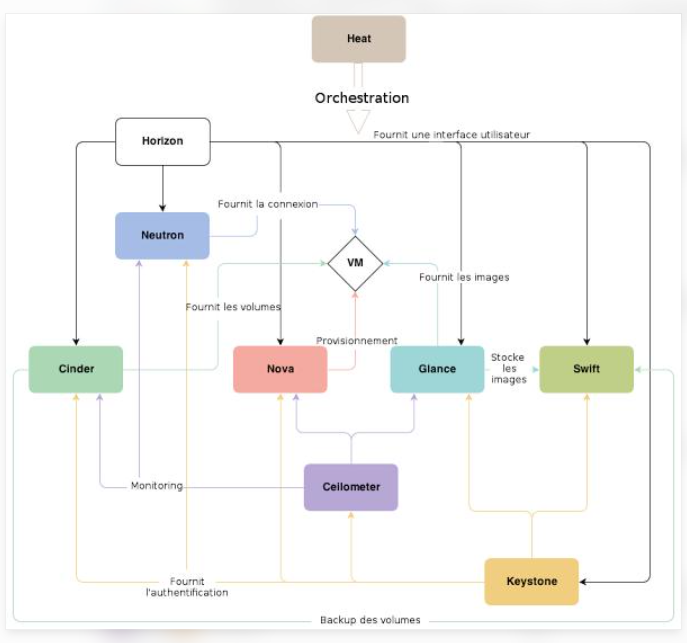
Common services include Keystone (identity/catalog), Nova (compute), Neutron (networking), Glance (images), Cinder (block storage) and Swift (object storage). Horizon provides a dashboard. Placement tracks resource inventories and allocations used by Nova. Heat provides orchestration, while Ceilometer may provide telemetry. Deployments may also include Manila for shared file systems and Ironic for bare-metal provisioning. The service set depends on requirements.
Q05. How do different components in OpenStack communicate with each other?
Services primarily communicate through REST APIs over HTTP/HTTPS, commonly exchanging JSON. A client authenticates with Keystone, receives a scoped token, discovers service URLs in the service catalog and presents the token to APIs. Internally, services may communicate asynchronously through RabbitMQ. Databases persist service state. REST APIs, message queues and databases have different roles.
Q06. What is the role of the message broker (RabbitMQ) in an OpenStack cluster?
RabbitMQ commonly provides the AMQP message bus for asynchronous remote procedure calls and notifications between service processes. It routes messages to queues so components can request work without synchronous direct calls. Acknowledgements and durable queues support reliable handling when configured. RabbitMQ does not store authoritative cloud resource state—that is held in service databases—and it is not the user-facing API endpoint.
Q07. What is Red Hat OpenStack Platform (RHOSP) and how does it differ from upstream OpenStack?
Upstream OpenStack is the community-developed open-source project and release stream. Red Hat OpenStack Platform is Red Hat's enterprise product and support offering, built from selected OpenStack components with tested integrations, packaging, lifecycle policies, documentation and vendor support. It may include vendor-specific deployment workflows and certified integrations. Capabilities and supported architectures vary by RHOSP release.
Q08. What is a "Tenant" (or Project) in OpenStack?
A project is a logical resource and ownership boundary. Users receive access through role assignments, and resources such as instances, networks, volumes and images can be associated with a project. Projects separate teams, customers, applications or environments in a multi-tenant cloud. Older terminology used tenant; modern Keystone and CLI terminology generally uses project. A project is not a separate physical infrastructure.
Q09. What is a "Role" in OpenStack?
A role is a named set of permissions used by policy rules to determine what an authenticated user may do. Keystone stores role definitions and assignments, such as assigning member to a user on a project. Assignments can be scoped to a project or domain; some deployments use system-scoped roles. Effective access also depends on service policy and token scope.
Q10. How can you view the list of roles in an OpenStack environment via the CLI?
Use `openstack role list` to display roles known to Keystone. Inspect one with `openstack role show <role-name-or-id>`. To view assignments, use `openstack role assignment list` with filters such as `--user`, `--project`, `--domain` or `--names`. Role definitions and assignments differ: listing roles does not show which users have each role.